AI is no longer a distant, futuristic idea. It already decides what shows up on your feed, predicts the fastest route on your ride-hailing app, and flags a suspicious transaction before you even notice it.
For a graduate stepping into college for the first time, that shift matters. How you use AI in these first few months can shape how fast you learn, how well you work, and how safe you stay online.
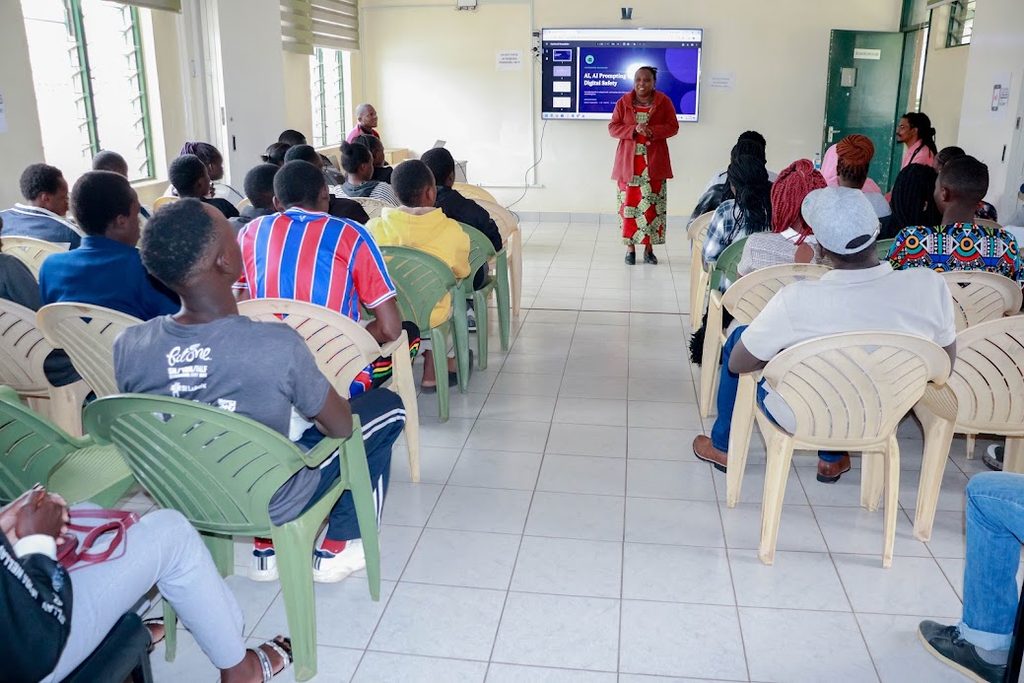
On Sunday, August 9, We (MustardSeed) brought this conversation to our newest mentees at St. Aloysius Gonzaga Secondary School, in a session titled Digital Literacy & AI Skills Training.
The afternoon session began with Marion Zireesi, the programs coordinator, introducing MustardSeed to the graduates and walking them through what the programme stands for and the kind of support it offers as they step into college life.
We were also privileged to have Dr. Lucina Koiyo, the President of the CLC in attendance. She gave a short address emphasizing the importance of showing up for sessions like this and how the habits built early in college often carry into a graduate’s career years later.
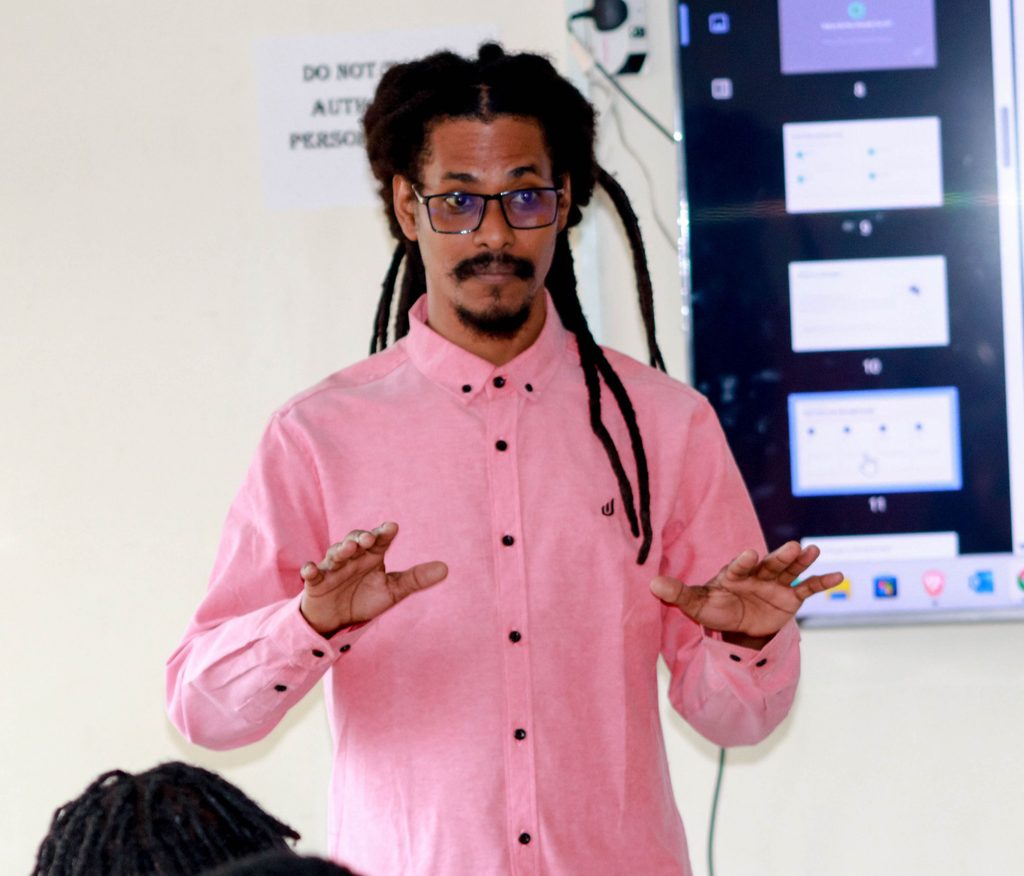
The training itself was handled by George Agak, a copywriter and digital literacy facilitator with over a decade of experience working across digital platforms. In this write-up, we’ll go over some of the ground he covered.
Note: this isn’t a transcript of the full session, just a summary of the key ideas for those of you who couldn’t join us. To catch a session like this live, come through to one of our monthly meetings.
Digital literacy, narrowed down to AI
Digital literacy is a broad idea. It covers everything from basic device skills to online research and communication.
George narrowed the afternoon to what AI actually is, how to get useful results out of it, and how to use it without getting scammed. A smaller, more workable slice of a subject that can otherwise feel overwhelming.
The art of the prompt
Most people’s first real interaction with AI is a prompt, the instruction you type into a chatbot. George’s central argument was that this is a skill in its own right, not something you either “get” or don’t. It’s something you can learn and perfect.
It has a formula.
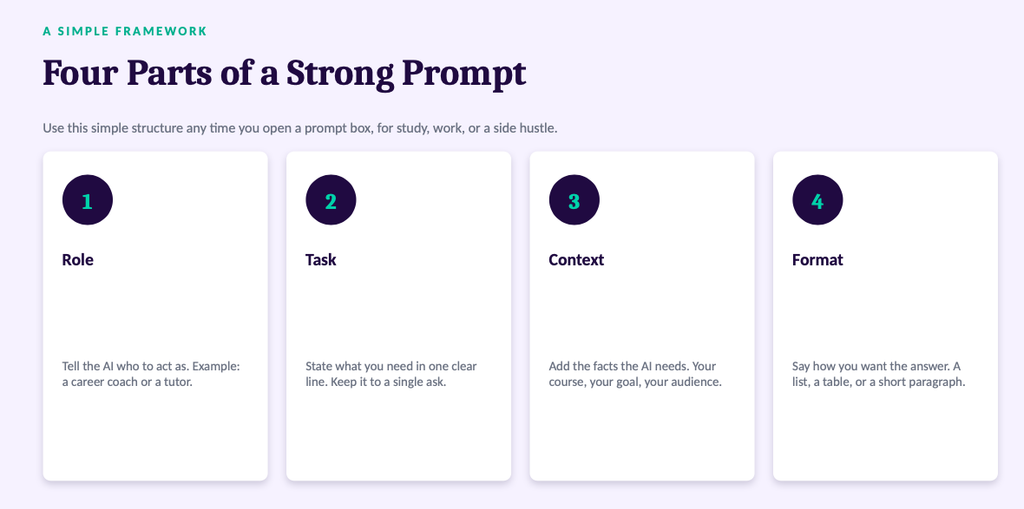
A strong prompt, he explained, has four parts: a role for the AI to act as, a clear task, enough context to work with, and a format for the answer.
He demonstrated how haphazard prompts yield vague results, and why the four-part formula is essential in getting the best from AI tools.
He illustrated it with a deliberately unusual example, a painter trying to work out which acrylic colors to mix for a client’s commission.
Weak vs. strong prompt:
Weak: “What colors should I use?”
Strong: “Act as a color theory expert. My client wants a warm, earthy portrait background. Suggest three acrylic color combinations and how to mix each one.”
The lesson landed. The same small structure; a role, a task, context, and a format, turns a vague question into a useful answer, whether the work happens on a screen or at an easel.
AI at work: career, hustles, and learning
George then walked the graduates through where AI already earns its keep.
For career growth, he pointed to tools like Kickresume and Rezi for polishing a CV, Yoodli and Google’s Interview Warmup for practicing interview answers, and AI search tools for finding job openings and internships.
For side hustles, he named tools professionals already lean on: Claude and Jasper for writing, Canva Magic Design and Midjourney for design work, Copy.ai for social captions, and CapCut or Descript for video editing.
For learning, he encouraged the graduates to use AI to break down hard topics, build practice quizzes, and get a second, simpler explanation when a lecture moves too fast. While at it he cautioned them to never submit AI-written work as their own.
He also advised those using AI for job search to be vigilant because AI makes scams faster and even harder to detect. On this, he pointed to a sobering statistic: the FBI logged about $13 million in job scam losses tied to deepfake interviews in 2025. His advice was simple. Verify a recruiter through a second channel before you hand over personal information.
Stay a step ahead of what’s fake
The final part of the session moved from opportunity to defense. George walked the class through the threats users are likely to run into. Old ones like phishing and fake job posts, and newer ones like cloned voices and deepfake video calls.
He introduced OSINT, open source intelligence, as an accessible way to check whether something online is real, using public information like search engines and public records rather than any special software.
The graduates left with a short list of online safety habits: run a reverse image search before believing a suspicious photo, check an unfamiliar source before trusting it, cross-check a claim with two or three independent outlets, and use fact-checkers like Africa Check and PesaCheck for claims closer to home.
The session ended with career opportunities in AI and cybersecurity. An area the young mentees could exploit to broaden their career options in a fast-paced, AI-powered job market.
As MustardSeed, we’re grateful to George Agak for putting together such a thorough, practical session for our newest mentees, and to Marion, Joseph, and Dr. Lucina for setting the tone for the afternoon.